
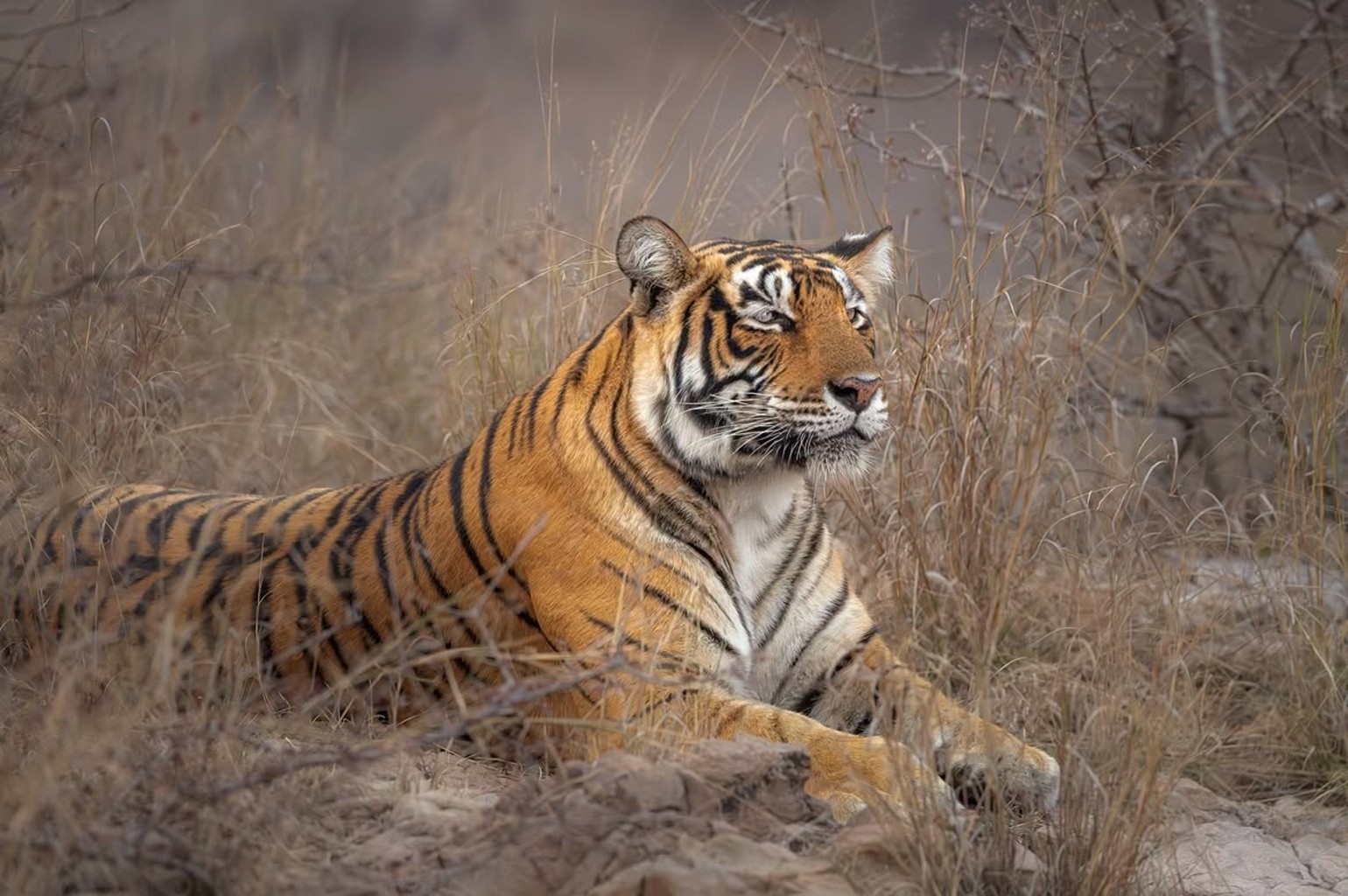
Ranthambore’s Premier Male Tiger
Every tiger reserve has its alpha male, and in Ranthambore that title belongs unambiguously to Sultan, designated T-72 in the park census. Built on a monumental scale — rangers estimate his weight above 250 kilograms — Sultan combines raw physical power with battle-tested experience. Deep scars etched across his muzzle and shoulders tell the story of territorial confrontations won over many seasons.
A Territory Forged in Conflict
Sultan’s stronghold is Zone 5, the Bakola sector situated beneath the ramparts of the Ranthambore Fort. He wrested this territory from an older male through a series of confrontations that park trackers documented over several months. Since establishing dominance he has extended his patrol routes to include peripheral waterholes in the Zone 4 buffer, occasionally clashing with younger males attempting to encroach from the south.
His marking behaviour is prolific. Visitors on early-morning safaris often spot fresh scrape marks and scent deposits along trail junctions, evidence of Sultan’s nightly circuits through his domain.
Genetic Architect of the Park
Sultan’s importance extends beyond his individual presence. He has mated with several resident females across multiple zones, spreading his robust genetics through the Ranthambore population. Wildlife geneticists tracking the park’s breeding lines consider Sultan one of the most consequential sires in the reserve’s recent history. His offspring have been identified in at least four distinct zones.
The Dawn Encounter
Safari veterans describe a particular spectacle: Sultan emerging from the tall Bakola grasslands at first light, dew glistening on his coat, his massive frame silhouetted against the misty backdrop of the fort. This image has become one of the most reproduced motifs in Indian wildlife photography.
“Sultan does not merely inhabit Zone 5 — he defines it. Every other animal in that sector arranges its behaviour around his movements. That is the mark of a true apex predator.”